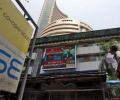
Equity benchmark indices Sensex and Nifty buckled under selling pressure after a nine-session rally on Monday, as massive sell-off in IT, tech and telecom counters unnerved investors.

Fresh plans of privatisation or divestment in central public sector enterprises and public sector banks might take a back seat this financial year because these may require a large consensus among coalition partners.

'This segment has performed very well for us and this is reflected in our bounce rate which is about three to four per cent.'

Consensus remained elusive on a common BRICS currency as business leaders from the five-bloc nations debated the pivotal issue at a business forum on the periphery of a summit of the five-member bloc being hosted here by South Africa. In their two addresses at the Summit so far, the leaders of Brazil, Russia, India, China and South Africa have made no or scant references to the issue either. "The BRICS Business Forum discussed the international payments system in detail. "Participants also debated the question of whether a BRICS currency is possible or desirable, with strong views expressed both for and against and little consensus reached," Sim Tshabalala, chief executive of Standard Bank Group, told several hundred captains of industry from the partner countries and over 40 other nations across the globe at the Summit.

Among the Sensex firms, Kotak Mahindra Bank, Tata Steel, ITC, ICICI Bank, Bajaj Finserv, Maruti, Mahindra & Mahindra and State Bank of India were the biggest winners. Tata Consultancy Services, Infosys, HCL Technologies, Tech Mahindra, Asian Paints, Wipro and Tata Motors were the biggest laggards.

The avoidable stresses and strains in ties helped in one way. It showed for the entire region how a matured India handled diplomatic relations, especially with a smaller and suspicious neighbour, with practised dignity and patience, unruffled by provocations in word, deed and action, observes N Sathiya Moorthy.

Like everything else, the structure of banks may change, and banks may depend more on digital technologies and artificial intelligence for dealing with both their customers and employees.
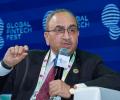
'We have a plan to plough back a 'This year in the first half we had profits of more than Rs 31,000 crore.' significant amount of profits this financial year.' 'We have seen this organic plough back of profit is one of best ways to support the equity of the bank.'

A mixed global trend and weakness in rupee influenced the sentiments during the day.

IFMR Capital previously pioneered the multi-originator securitisation.

'India has the potential to do a lot more to take advantage of the time today where we stand to gain, geopolitically and in terms of market attractiveness.'

'There is no tried and true recipe for creating Silicon Valleys.' 'Attracting and creating a mass of truly dynamic entrepreneurs is at the core and among the hardest and most necessary ingredients.' 'In the US, close to 60% of the top valued tech companies were started by immigrants who found the start-up climate to be superior to where they came from.' 'India would clearly benefit from attracting back its talented Diaspora, but it also needs to hold onto those entrepreneurs.'

Low home loan rates by banks could put large players in an advantageous position over smaller non-bank players, believe analysts.

For FY21, CSB is looking at growth of around 25 per cent and is confident of doubling it in two years. And it is also exploring options to acquire a mid-size bank with a good client base and branches in the north to acquire an all-India presence.

Foreign banks were ahead in terms of technology, but that is no longer the case as Indian private banks steal the innovation march.
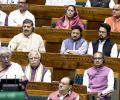
Finance Minister Nirmala Sitharaman on Tuesday announced income tax relief for the middle class, a Rs 2 lakh crore outlay for job creation schemes over the next five years and a spending splurge for states run by her party's new coalition partners as she unveiled the Modi 3.0 government's first budget after the general elections.

Sensex climbs higher on favourable global cues.

The share of listed public sector undertakings (PSUs) in the overall market capitalisation has hit a three-year high of 11.4 per cent. This comes on the back of the sharp outperformance of the PSU pack over the past two years. In 2021 and 2022, the BSE PSU index gained 41 per cent and 23 per cent, respectively. Market participants said a combination of factors like value buying and bullishness, particularly in public sector banks (PSBs), were the reason for the improved prospects.

'The private sector believes that some enablers in labour-intensive sectors like apparel, toys, tourism, and media retail, can unlock a lot of jobs.'

The 30-share Sensex ended higher by 177.46 points at 28,885.21 and the Nifty gained 63.90 points at 8,778.30.

As with TCS, most companies put their money in mutual funds, corporate bonds and bank deposits, which are losing their appeal versus government bonds in terms of both returns and safety.

Privatisation or consolidation into half a dozen large banks might not rescue public sector banks from the crisis they find themselves in.

Given the uncertain macroeconomic conditions, most brokerages have turned slightly cautious on the pace of growth in State Bank of India's (SBI's) earnings going ahead. While they don't see any significant risk arising for now, its sheer balance sheet size and systematic importance has nudged them to cut earnings estimates for fiscal year 2023-24 (FY24) and 2024-25 (FY25) up to 5 per cent. India's largest state-owned bank, on Thursday, reported standalone net profit of Rs 16,694.51 crore for Q4FY23.

Assuming we still have a Modi-led majority government after May 2024, there is no guarantee that reforms will move at anything more than a snail's pace, though we must be thankful even for that, notes R Jagannathan.

Brokers have requested for a three-month extension from the Securities and Exchange Board of India (Sebi) for the validation of Know Your Client (KYC) records. In a letter to Sebi, industry body -- Association of National Exchanges Members of India (Anmi) -- has cited various issues and concerns raised by its members that have hampered the smooth completion of the validation process within the stipulated timeline. The Sebi circular had given KYC Registration Agencies (KRAs) a timeline of 180 days, ending on April 30, 2023, to validate client KYCs.

Indian cities need $840 bn investment over 15 yrs, says World Bank report.

Leading stock exchanges BSE and NSE on Friday decided to drop Yes Bank from Futures and Options segment from May 29. The existing Futures and Options contracts across all expiries will expire on May 28.

There would be no retrenchment of employees and that their services conditions would also not be affected post merger.

Motilal Oswal of Motilal Oswal Financial Services tells Puneet Wadhwa why he thinks the current market levels will sustain.

Henry Kravis, co-founder of global private equity firm Kohlberg Kravis Roberts & Co, thinks India should go for a bad bank to deal with bad assets in banks. In an interaction with journalists in Delhi, he says there are plenty of opportunities in India. He was joined by India CEO Sanjay Nayar.

As many as 10 public sector banks could be out of the infusion plan because of Sebi's minimum public shareholding norms.

Few finance ministers announce any taxation measure that could upset the stock market. Ms Sitharaman decided to take that risk, observes A K Bhattacharya.

State-owned companies have been set stiff targets to increase accountability as they get ready for divestment. Nikunj Ohri explains why meeting them will be challenging.
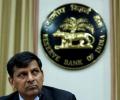
Here is some background on the candidates seen as potential successors to Rajan at the RBI
In the context of market integrity, the IRAI and RBI should go over the minutes of the LIC and SBI board meetings when the decisions to invest in Adani equity or debt were taken, notes Jaimini Bhagwati, former World Bank treasury professional.

Notwithstanding concerns about lofty valuations, smallcaps recorded their most significant monthly gain in nearly three years in November. The National Stock Exchange Nifty Smallcap 100 finished the month with a 12 per cent gain, the most since February 2021 when it rose by 12.2 per cent. After declining by 4.1 per cent in the preceding month, the Nifty Midcap 100 rose by 10.4 per cent, the most since July 2022.

CII said working capital limit enhancement should be accompanied by relaxing norms related to collaterals.

Among the Sensex firms, Bajaj Finserv, Tata Motors, Asian Paints, ITC, IndusInd Bank, State Bank of India, Tata Steel, Wipro, Infosys and Maruti were the major gainers. Tech Mahindra, HCL Technologies, Kotak Mahindra Bank, Titan and Larsen & Toubro were the major laggards.

The action comes days after the CBI registered an FIR in the country's biggest alleged bank loan fraud case till date.

SBI Capital Markets Limited, the merchant banking arm of SBI, is eyeing the twin accounts of HPCL and BPCL for managing the divestment programmes of the 2 oil cos.
